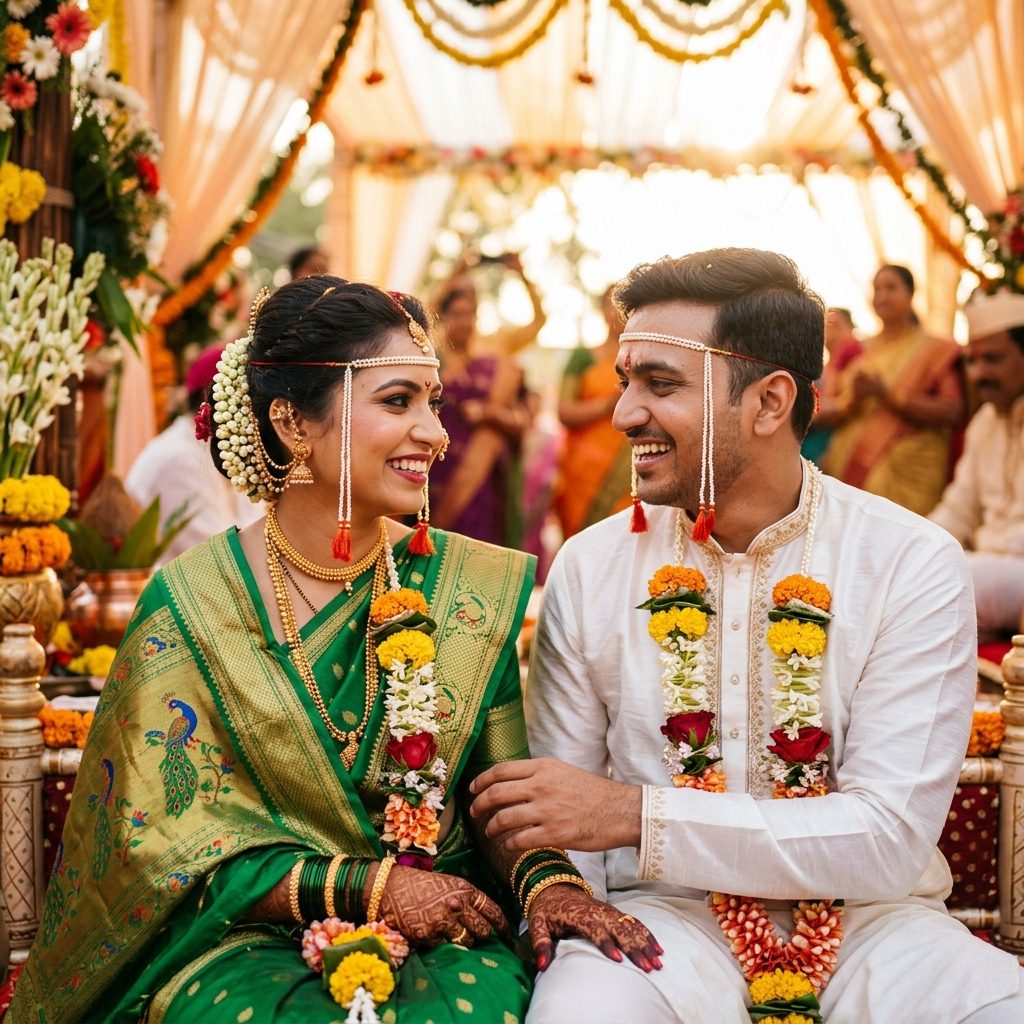
Maharashtrian weddings, or 'Lagna', are celebrated for their beautiful simplicity, deep-rooted Vedic traditions, and joyful family bonding. Unlike the grand, opulent celebrations seen in other parts of India, a traditional Marathi wedding focuses heavily on sacred rituals and heartfelt customs. Every ceremony, from the pre-wedding preparations to the final welcoming of the bride, holds a profound spiritual and social significance designed to bless the union of two souls.
Sacred Pre-Wedding Milestones
The journey begins with the Sakhar Puda, which is the formal engagement ceremony. Literally translating to 'a packet of sugar', the groom's family presents the bride with sugar, symbolizing the sweet beginning of their relationship and the formalization of the match. Following this is the Kelvan, a series of warm family luncheons or dinners where close relatives host the bride and groom, showering them with gifts, traditional Marathi delicacies, and blessings. Just a day before the wedding, the Halad Chadavane takes place. During this ceremony, a paste of fresh turmeric is applied to the bride and groom by married women, starting at the groom's house and then using the remaining paste for the bride, signifying purification and prosperity.
The High Points of the Wedding Day
On the wedding day, the rituals begin with the Seeman Puja, where the bride's parents welcome the groom and his family at the boundary of the wedding hall, washing his feet and offering gifts. The main ceremony commences with the Antarpat, a silk curtain held between the couple to prevent them from seeing each other until the astrologically calculated auspicious moment. As the priests chant the Mangalashtaka—eight sacred verses invoking blessings from all deities—the anticipation builds. At the final verse, the Antarpat is lowered, and guests shower the couple with Akshata (sanctified rice grains) amidst the joyous sounding of the shehnai.
“The lowering of the Antarpat represents the removal of physical and spiritual barriers between the couple, allowing their souls to merge into one shared destiny under the gaze of the divine.”
Following this emotional moment, the Kanyadaan ceremony takes place, where the father gives away his daughter to the groom. This leads into the Laja Hom, where parched grains are offered to the sacred fire, and the Saptapadi, where the couple takes seven steps together around the fire. Each step signifies a specific promise—ranging from sharing household duties and nurturing children to remaining lifelong friends and spiritual partners.
Welcoming the Bride and Modern Planning
The wedding concludes with the Varat, the bridal procession to the groom's house, followed by the Grihapravesh. At the threshold of her new home, the bride gently knocks over a small vessel filled with rice (a kalash) using her right foot, symbolizing the entry of Lakshmi, the goddess of wealth and prosperity, into the household. She then dips her feet in vermilion water and walks onto a white sheet, leaving red footprints that represent her auspicious presence.
Planning these intricate rituals requires careful organization and timely coordination with family and friends. To share the joy of your upcoming Marathi wedding seamlessly, you can design traditional, elegant digital invitations using the Shubh Muhrat Invite Studio, making it simple to invite your loved ones to witness your sacred vows.